


Breaking the Technical Bottleneck of 976nm Pump Source — Integrated Grating Chip Module
03/21
2025
Changguang Huaxin is a domestic enterprise that first proposed and advocated the application of the 976nm pump scheme in the industrial field. After years of practice, the 976nm pump scheme has become the mainstream solution in the market. However, with the deepening application of fiber lasers in high-end manufacturing, scientific research, and other fields, the performance requirements for upstream pump sources have become more stringent, and some issues of the 976nm pump scheme have increasingly emerged. Changguang Huaxin, customer-centered, develops integrated grating chip modules around application challenges, bringing new opportunities for industry development.
The 976nm pump scheme has significant advantages
Yb-doped fiber lasers generally use the 976nm pump band to achieve higher power and better beam quality. Compared with the traditional 915nm pump, its core advantages include:
-
Quantum defect reduced by 20% , system efficiency increased to >40%
-
Absorption cross-section increased 3 times , allowing the use of shorter fibers to achieve the same gain and suppress nonlinear effects
-
Thermal load reduced by 30% , significantly reducing the complexity of the cooling system
Challenges faced by the 976nm pump:
1) Absorption peak spectral width is less than 10nm, wavelength shift greater than 0.5nm, causing cliff-like efficiency drop;
2) Limitations of traditional external cavity VBG wavelength locking schemes:
-
Narrow locking range: Can only lock wavelength within a limited temperature or current range; temperature fluctuations or current changes easily cause unlocking;
-
Requires temperature control system: External cavity VBG requires temperature control to compensate for semiconductor diode wavelength drift, ensuring pump light is fully absorbed at all operating currents and temperatures, increasing system size and power consumption;
-
Residual light stripping burden: Unabsorbed pump light needs to be dissipated through cladding light strippers, increasing system complexity and cost.
-
High cost: External cavity VBG materials and complex optical assembly processes lead to increased pump source size and cost, increasing system size and cost;
-
Spectral locking time: Spectral locking time ~100ms, unable to meet special application requirements
Breaking the technical bottleneck of the 976nm pump source — integrated grating chip module
To break the technical bottleneck of the 976nm pump, Changguang Huaxin developed an integrated grating laser chip fiber-coupled module:
1) 300W 135/155μm sample module
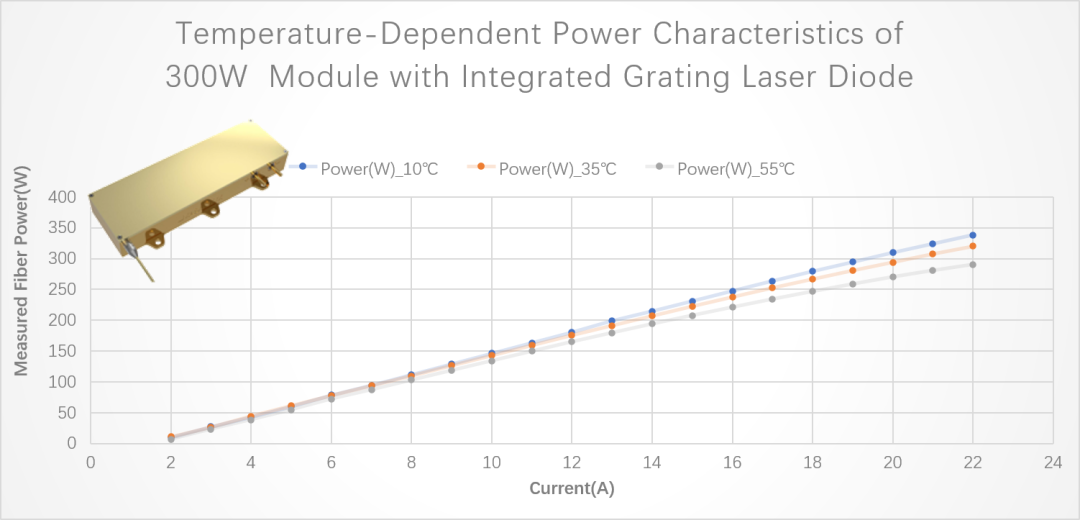
△ Sample module temperature-dependent power characteristics
This module uses a unique epitaxial chip design to achieve linear power output over a wide temperature range, ensuring stable performance of the laser under different environmental conditions. The developed 300W 135/155μm sample module fiber output is compatible with mainstream gain fibers and can be easily integrated into existing fiber laser systems without additional modifications.
2) >55℃ wide temperature wavelength locking
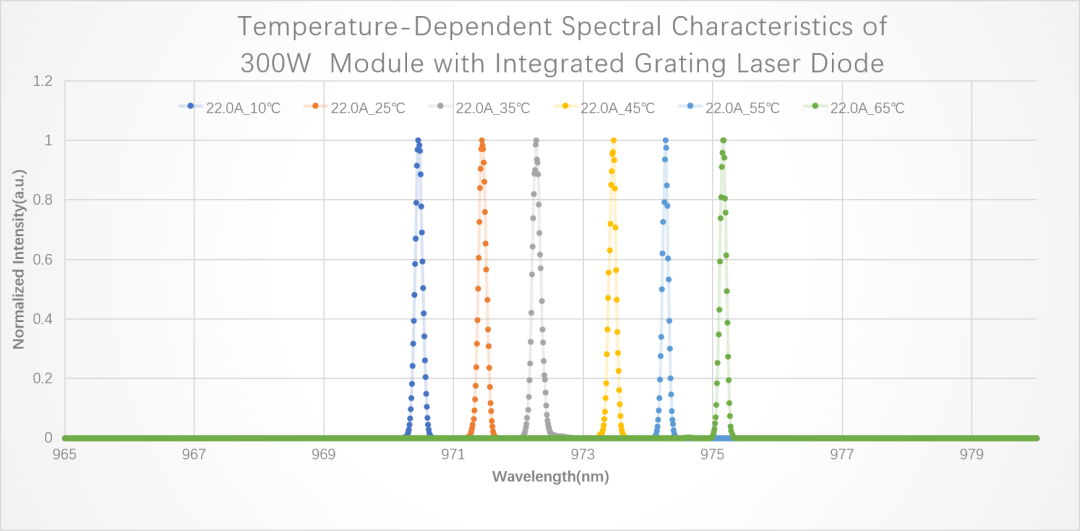
△ Sample module temperature-dependent spectral characteristics
Test data shows that this sample module can achieve full current spectral locking over a wide temperature range of 10℃~65℃, with spectral FWHM <0.4nm, without additional external cavity optical components, effectively reducing product cost and improving environmental adaptability.
3) Low temperature wavelength drift coefficient (0.07nm/℃)
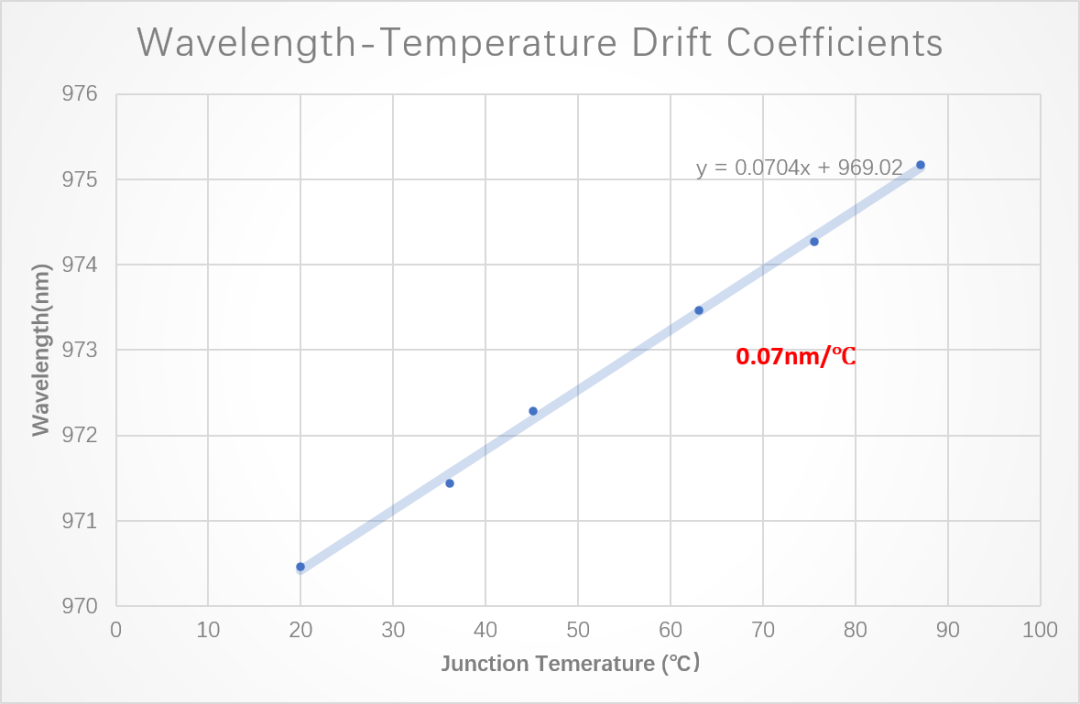
△ Wavelength-temperature drift coefficient
A wavelength temperature drift coefficient of 0.07nm/℃ ensures that the pump light spectrum remains within the gain absorption band under wide temperature operation, guaranteeing stable gain bandwidth, which helps the laser output stable single-mode or few-mode laser and improves laser quality.
4) Low wavelength locking time (<10ms)
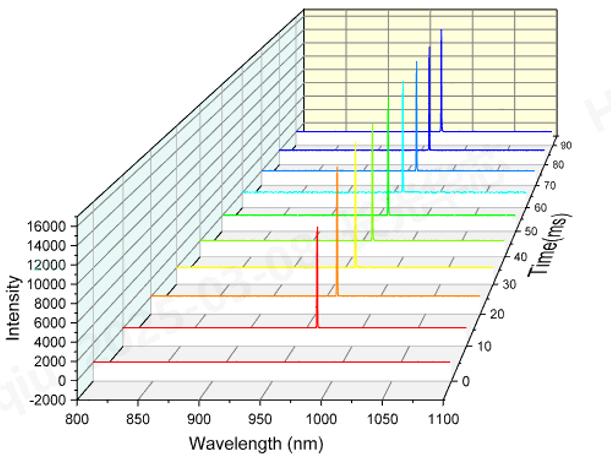
△ Time-wavelength-intensity graph
Tested results show that the time from light emission from the sample module to stable locking of the laser output wavelength is less than 10ms. This performance ensures fast response and high-precision control of the laser in practical applications, suitable for various high-demand laser application scenarios.
5) Chip reliability (2 batches 1000h no failure!)
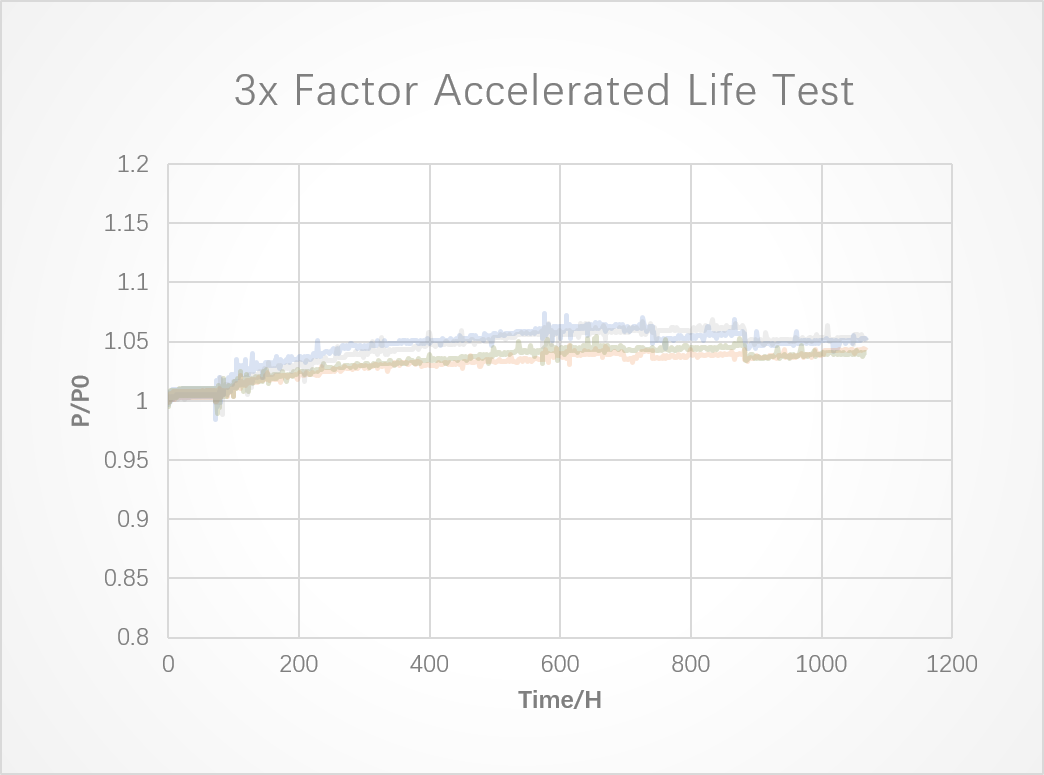
△ 3x accelerated life test
The grating integrated chip passed two batches of 1000-hour accelerated life verification with no failures! The stable grating integrated chip ensures stable laser output, reduces downtime caused by grating failures, and guarantees long-term stable operation of fiber lasers in practical applications.
The emergence of this product is expected to break the technical bottleneck of traditional pump sources, promote the further development of fiber laser technology, and meet the market demand for higher power, better beam quality, and higher reliability!
Recommended Reading

Address: No.56,Lijiang Road,SND,Suzhou,Jiangsu Province,P.R.China
Mailbox:sales@everbrightphotonics.com
Website:www.everbrightphotonics.com
Phone:+86 0512-66896988
Fax:+86 0512-66806323
Message Board