


Frontier Technology | Research on Direct Semiconductor Lasers Based on Dense Spectral Beam Combining Technology of Single-Emitter Semiconductor Laser Diode Chips
10/20
2022
Hao Yu a , Shaoyang Tan a , Huadong Pan a,b , Shujuan Sun a , Pengyuan Lin a , Huan Hu a , and Jun Wang a,b
a Suzhou Everbright Photonics Co., Ltd, Suzhou 215163, P.R. China
b Sichuan University, Chengdu 610065, P.R.China
Hao Yu a , Shaoyang Tan a , Huadong Pan a,b , Shujuan Sun a , Pengyuan Lin a , Huan Hu a , Jun Wang a,b
a Suzhou Everbright Photonics Co., Ltd, Suzhou
b Sichuan University, Chengdu
Hao Yu, Shaoyang Tan, Huadong Pan, Shujuan Sun, Pengyuan Lin, Huan Hu, Jun Wang, "High-brightness fiber-coupled diode module using dense wavelength beam combining technology based on single emitter for material processing and fiber amplifier pumping," Proc. SPIE 11983, High-Power Diode Laser Technology XX, 119830A (4 March 2022); doi: 10.1117/12.2608686
Abstract
Fiber-coupled modules have the advantages of high efficiency and high reliability and are widely used in material processing and fiber laser pumping. Conventional fiber-coupled modules based on spatial beam combining and polarization beam combining cannot meet the brightness requirements of many applications, such as metal material cutting which requires optical power exceeding 1kW , beam quality better than several mm*mrad . Dense wavelength beam combining technology can greatly increase output power while maintaining output beam quality, making high-brightness applications of fiber-coupled modules possible. By using semiconductor laser single emitter chips instead of semiconductor laser bar chips in dense wavelength beam combining technology, the efficiency, reliability, and brightness of fiber-coupled modules can be improved. We have developed 2 a high-brightness fiber-coupled module based on single emitter dense wavelength beam combining technology for material processing and fiber amplifier pumping applications. 100 μ m/0.22 NA 2kW fiber-coupled module. This 2 high-brightness module respectively has 953-991nm spectral, 50% electro-optical conversion efficiency and narrower spectrum, 48% electro-optical conversion efficiency. We also combined 15 units of 100 μ m/0.22 NA 1.4kW high-brightness modules by fiber combining, successfully achieving 600 μ m/0.22 NA fiber super 22kW output.
1. Background Introduction
Direct semiconductor ( Direct Diode Laser , DDL ) lasers have many advantages, such as high efficiency, high reliability, high compactness, and lightweight, and are widely used in the field of material processing. Traditional DDL lasers use spatial beam combining, polarization beam combining, and wide wavelength beam combining to increase output power. Although power has been increased, the improvement in brightness is very limited, insufficient for thick metal cutting, and impossible for applications requiring brightness exceeding 160MW/cm2-sr Raman fiber amplifier pumping [1] . Dense wavelength beam combining ( Dense Wavelength Beam Combining , DWBC ) and coherent beam combining ( Coherent Beam Combining , CBC ) can both be used to greatly improve DDL laser output brightness. However, the complexity and difficulty of high-power semiconductor lasers CBC limit the maximum output power, currently below 50W[2-3] . DWBC At the cost of sacrificing spectral width, it does not require laser phase control, reducing the complexity and difficulty of the entire system.
Semiconductor laser bar chips, due to their high integration, can achieve efficient assembly of optical devices and are the most common light source in DWBC . However, the "smile" effect and low polarization degree of bar chips reduce the output brightness and electro-optical efficiency of high-brightness smile lasers. In addition, the compactness of bar chips inevitably brings thermal crosstalk between emission points on the bar chip, further limiting the improvement of output power and brightness. To achieve higher brightness, higher reliability, and higher electro-optical conversion efficiency, Everbright Photonics has developed a DDL technology based on semiconductor laser single emitter chips. Although the optical device assembly time of single emitter chips is higher than that of bar chips because each single emitter chip requires individual optical shaping, the individual optical shaping provides DWBC 技术。虽然单管芯片的光学器件组装时间高于巴条芯片,因为每一个单管芯片都需要单独进行光学整形,但是单独的光学整形反而提供了5 Degrees of freedom are used to correct the position and directivity between beams, further enhancing high brightness DDL Laser performance.
Changguang Huaxin focuses on modular design, developing a spatial output engine based on single-chip technology DWBC Technology's 1.5kW spatial output engines, then combining these engines to achieve high-power fiber-coupled output. Composed of 1.5kW spatial output engines, the high-power high-brightness fiber-coupled module not only simplifies assembly difficulty but also greatly improves product maintainability thanks to modular design.
2. 1.5kW Spatial Output Engine
1.5kW The engine uses Changguang Huaxin's independently developed 9xx nm series 120 μ m emitting area width single-chip as the light source. These single chips are all packaged on aluminum nitride ceramic heat sinks to achieve good heat dissipation. Previously developed 350W/50 μ m[5] and 600W/100 μ m[6] fiber-coupled modules use conventional M12 modules as packaged single-chip carriers. In 1.5kW spatial output engines, a brand-new M12F module is developed as a packaged single-chip carrier to reduce system size and volume. This brand-new M12F module has been applied in laser wireless power transmission systems [7] 。M12F The fast axis collimating lens ( Fast Axis Collimator , FAC ) and slow axis collimating lens ( Slow Axis Collimator , SAC ) and 45 ° mirror assembly are all based on Changguang Huaxin's independently developed active alignment ( Active Alignment , AA ) process automation equipment, M12F The module's near field ( Near Field , NF ) and far field ( Far Field , FF ) optimizations are fully automated.
Theoretically, the chip's free-running center wavelength should be as close as possible to the designed locked center wavelength to achieve high efficiency and high side-mode suppression ratio. By designing special epitaxial structures and optimizing the chip's front cavity coating, the new 9xx nm series 120 μ m emitting area width single-chip wavelength locking range exceeds 14A operating current, 25 ℃ operating temperature conditions exceeds 20nm , such as Figure 1 shows. At different locked center wavelengths, the module still outputs the same power. It is worth mentioning that all single chips used for DWBC come from Changguang Huaxin's 6 inch chip production line.
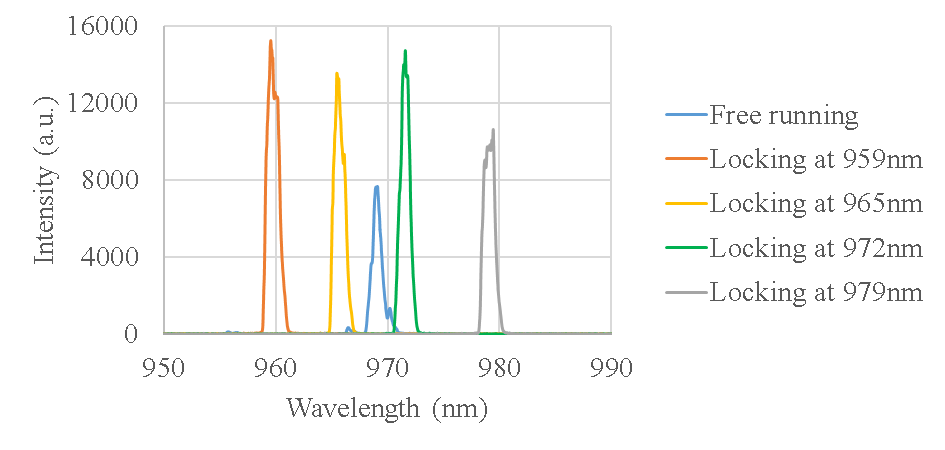
Figure 1. Wavelength locking result of M12F module with center wavelength of 969nm.
1.5kW The engine schematic is shown in Figure 2 shows the engine composed of 16 modules, the module's design locked wavelength ranges from M12F to 953 modules' beams are re-collimated in the fast and slow axis directions through cylindrical lenses with focal length of 991nm。16 To accommodate as many channels as possible within the bandwidth near 750mm and 1000mm a transmission grating with 40nm lines is used as a beam combiner to maximize laser output brightness. 1851 From /mm different reflectivity cavity mirrors are used to evaluate wavelength locking effect, concluding that 3% modules' beams are re-collimated in the fast and slow axis directions through cylindrical lenses with focal length of 15% feedback can achieve complete wavelength locking from threshold current to operating current. Therefore, the final choice is a cavity mirror with single-sided coating providing about 3% Fresnel 3% reflection. Between the grating and cavity mirror, there is a filtering system to ensure no crosstalk between chips and to filter out beams not wavelength-locked just in case. Finally, all beams pass through a Galilean telescope system with magnification placed behind the cavity mirror to balance fast and slow axis divergence angles. 2. 1.5kW Spatial Output Engine Schematic. 3 Figure 3
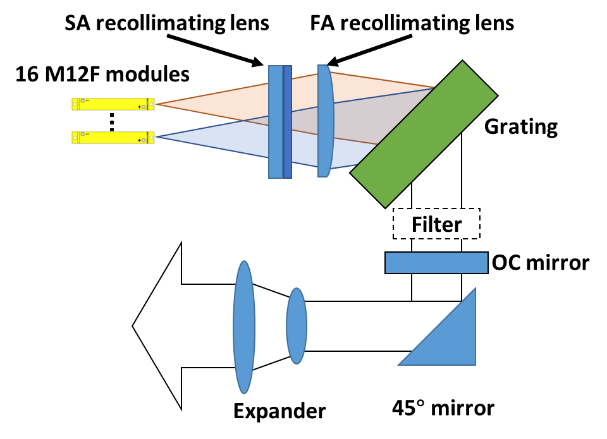
Figure shows the output power, electro-optical conversion efficiency (
Power Conversion Efficiency PCE DWBC Technology's 1.5kW ) and spectrum of the engine based on single-chip At peak, , reaches 52.1% 9A , at reaches 达到52.1%,在14A The maximum output power reaches 2.1kW In this engine, there are 5 chips that failed. If the failed chips are excluded, the maximum reaches will exceed 53% Meanwhile, the optical coatings used in the engine are not specifically optimized for 953 modules' beams are re-collimated in the fast and slow axis directions through cylindrical lenses with focal length of 991nm Within this wavelength range, the coating transmittance / reflectance is about 99.5% , the coating causes a few percent of additional power loss. The first and last M12F module locking center wavelengths are respectively 953.4nm and 991.2nm , the actually measured first and last M12F module locking center wavelengths are respectively 953.7nm and 991.5nm Through design and experimental comparison, the correctness of the theoretical design can be seen. At the same time, it proves that the optical assembly achieved extremely high precision throughout the manufacturing process.
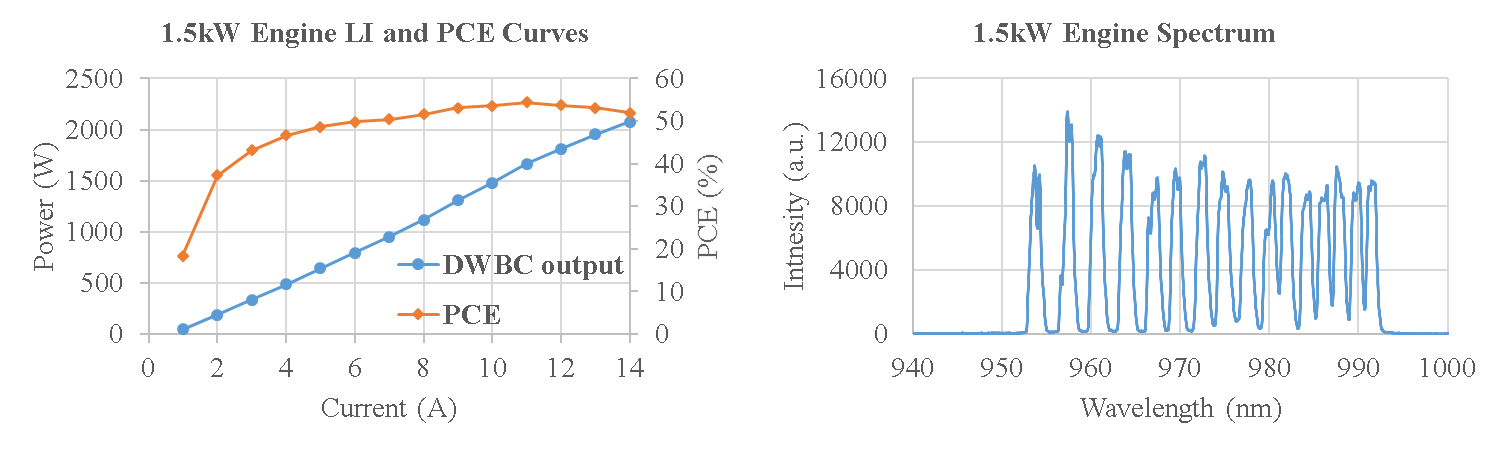
Figure 3. Left: 1.5kW engine LI and PCE curves. Right: 1.5kW engine 14A operating current output spectrum.
3. 2kW fiber-coupled module
1.5kW The engine output has a polarization degree exceeding 20dB of s polarization, so with only a slight power loss cost, the output brightness can be further improved by polarization beam combining. 2kW The fiber-coupled module consists of 2 units of 1.5kW engines. Before one engine, a half-wave plate is added to convert s polarized light into p polarization, then through a polarization beam combiner, two laser beams with different polarization states are combined in the NF and FF direction. Figure 4 shows the output results of the fiber-coupled module used for material processing. At 8A operating current, the output power exceeds 2.1kW、 reaches exceeding 50.5% . In single engine startup tests, each engine can output more than 100 μ m/0.22 NA QBH fiber power. However, 1.8kW engines tested simultaneously, when the current increased to 2 , the fiber and end cap fusion point at the fiber output end burned out, so higher operating current tests were not conducted. 9A The center wavelength deviation of the engines is 2 , so the number of peaks in the spectrum exceeds 0.5nm . 16 4. Left: 2kW/100μm fiber-coupled module LI and PCE curves. Right: 8A operating current output spectrum.
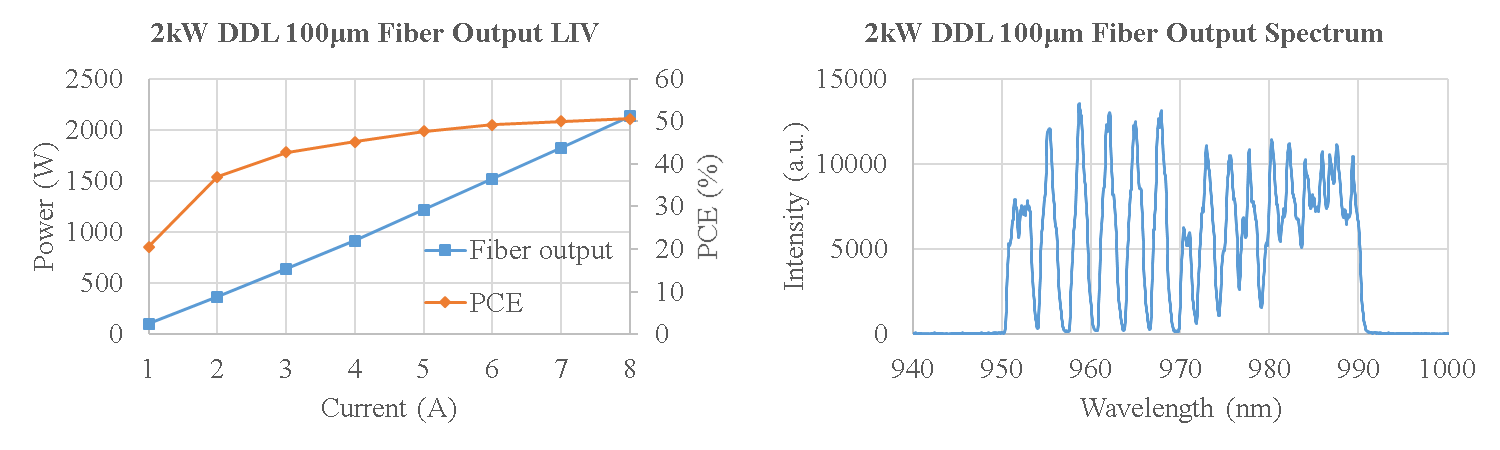
Figure In fiber amplifier pump applications, through precise alignment, it can be seen that the spectra of the engines completely overlap, as shown in
Figure 5 2 . To compress the spectral width, module was removed from the fiber-coupled module. The module's 12 units of M12F is 2kW/100 μ m 48.2% 13A operating current, the output power exceeds 2kW、 reaches Figure 6 shows. It is worth noting that this test result is bare fiber output, with no coating treatment at the output end. Additionally, the entire module underwent lifetime testing under , such as ℃ water cooling, humidity conditions, 25 hours power decay is less than 70% 5. 2kW/100μm fiber-coupled module 13A current output spectrum for fiber amplifier pump applications. 400 6. Left: 2kW/100μm fiber-coupled module LI and PCE curves for fiber amplifier pump applications. Right: full power 400-hour test results. 2%。
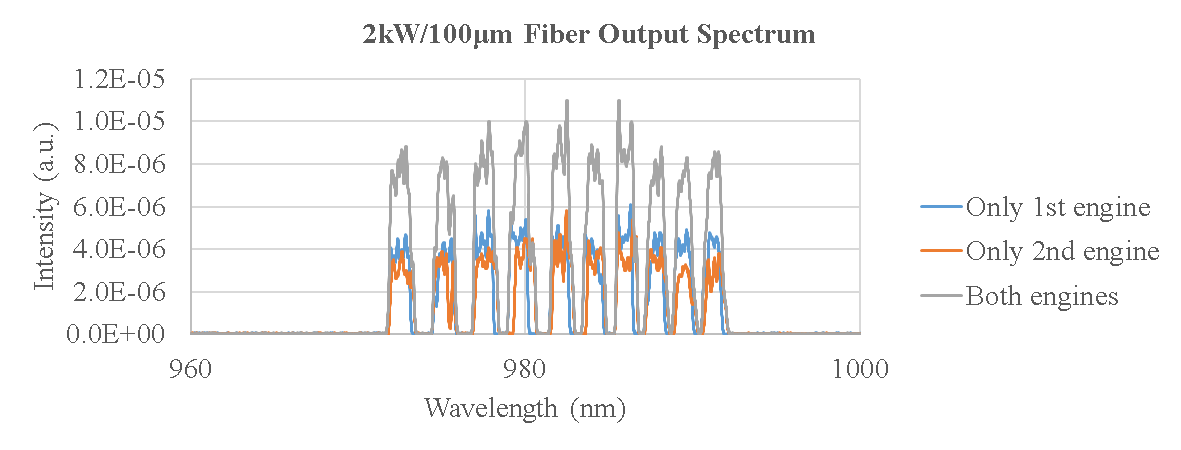
Figure Fiber combiners are often used to achieve output power enhancement and can be used to realize all-fiber
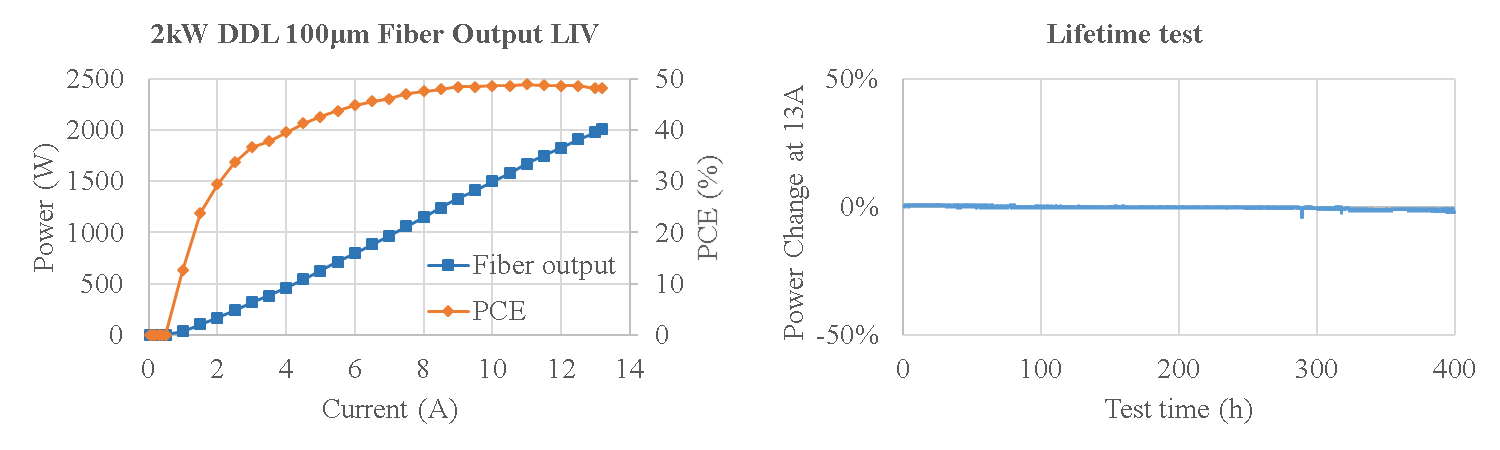
Figure systems without optical alignment. The beam quality of the input fiber and the light in the cladding of the fiber combiner need to be controlled because both affect the combiner's efficiency
[8] DDL . For conventional single-bar fiber-coupled modules using spatial and polarization beam combining technologies [9] , the of single-bar chips plays a decisive role in the beam quality of the fiber output. However, for modules, contrary to conventional fiber-coupled modules, the FF of single-bar chips plays a decisive role in the beam quality of the fiber output, and the 2kW width begins to shrink at high current NF [10] NF , so the fiber output beam quality is better at high current. In the optical design of the fiber-coupled module, light exceeding 0.17 NA 2kW/100 μ m is cut off by the aperture stop, so theoretically all the light of is within m/0.17 NA 100%的光都在 is within 内。100 μ m/0.17 NA fiber power. However, 2.1kW , whose output brightness exceeds 300MW/cm2-sr This brightness has already made DDL suitable for thick metal cutting and fiber amplifier pump applications. In addition, 2kW The fiber coupling module also uses a cladding power stripper ( Cladding Power Stripper , CPS ) for cladding light testing. By splicing a 100 μ m/0.22 NA in the middle of the power transmission fiber, CPS observe the temperature change of CPS It can be seen that under the condition of 2kW power input and no water cooling, CPS the temperature of 40.5 is only °C, as shown in Figure 7.
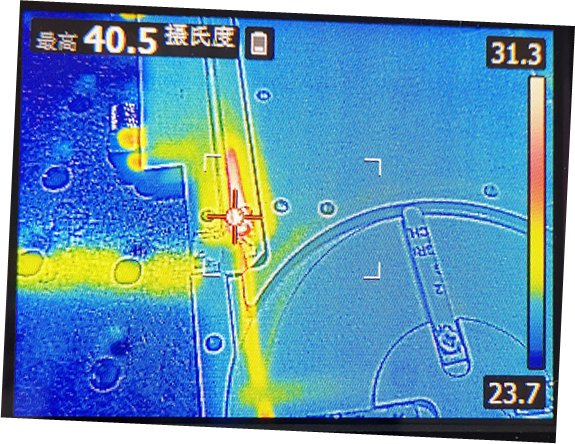
Figure 7. Temperature of 100μm/0.22 NA fiber CPS after stabilization under 2kW input and no water cooling.
4. 21kW DDL
The ultimate goal of the entire project is to output 600 μ m/0.22 NA QD interface fiber output 21kW power. 2 Two optical designs with different design philosophies can achieve this goal, namely spatial beam combining design and fiber beam combining design, each with its own advantages and disadvantages. Spatial beam combining design can output higher brightness, but the design and assembly difficulty of the entire DDL system is greatly increased. In comparison, fiber beam combining design can greatly improve the reliability of the entire system, but it comes with 20% beam quality degradation. For example, 1.5kW The beam quality of the spatial output engine is 7mm*mrad , according to the beam model [11] , it is known that 600 μ m/0.22 NA the fiber can allow a maximum of 29 engines for fiber coupling. Through 100 μ m/0.22 NA fiber combining to 600 μ m/0.22 NA fiber output, the maximum number of engines is only 19 units. However, 15 units through 100 μ m/0.22 NA fiber coupling of 1.5kW engines are enough to provide 21kW output. Therefore, the project ultimately chose the fiber beam combining scheme. Some 1.5kW engines' short-wave and long-wave M12F modules were removed, 15 units of 1.5kW fiber coupling modules output an average power of 12A at 1.4kW。 Figure 8 shows the 21kW fiber output DDL laser structure, 15 units of fiber coupling modules achieve 1 modules, the module's design locked wavelength ranges from 19X1 fiber output through 600 μ m/0.22 NA beam combiners.
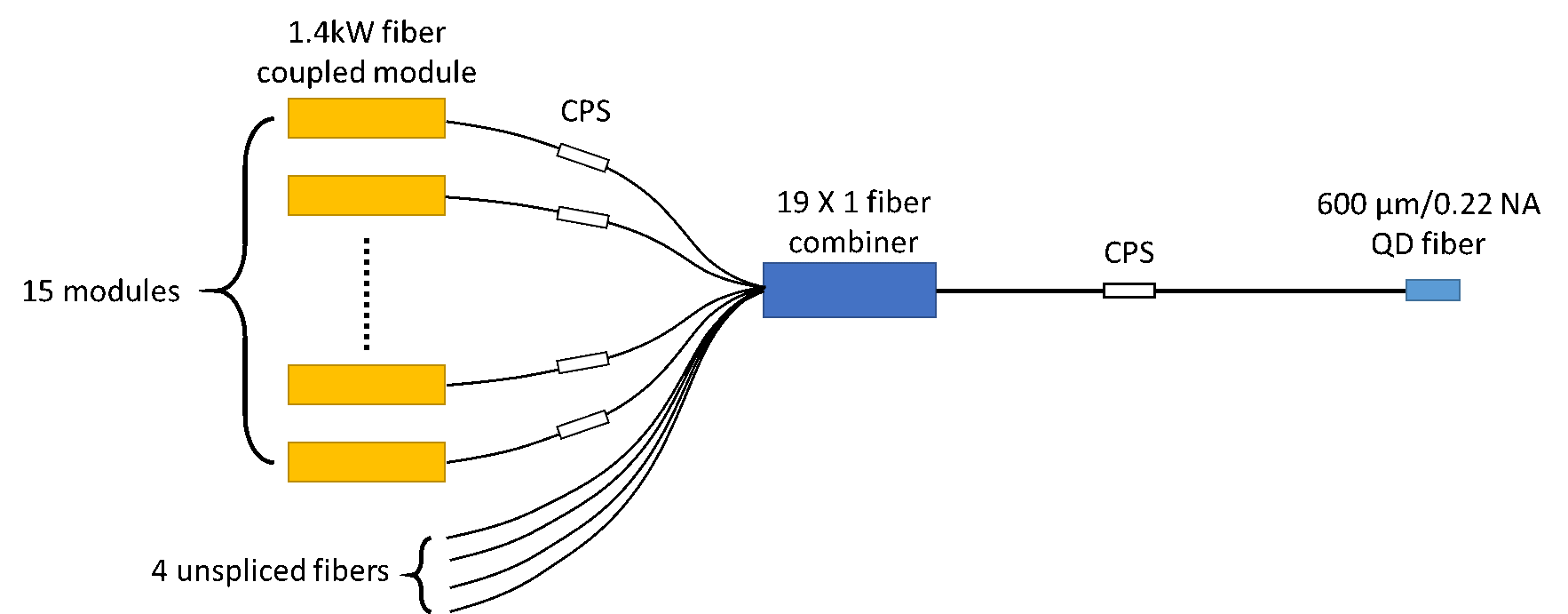
Figure 8. Schematic diagram of 21kW fiber output DDL laser structure.
Figure 9 and Figure 10 shows the 21kW fiber output DDL Laser output power and output spectrum. 21kW The laser outputs more than 13A at current 22.9kW . When the current exceeds 10A thermal rollover occurs due to insufficient water cooling. It is very obvious that 15 the spectra of the units of lasers completely overlap, so the number of peaks in the spectrum is exactly 16 . The power loss of each laser caused by the beam combiner was also analyzed. The power output from the laser through 600 μ m/0.22 NA fiber output compared to 100 μ m/0.22 NA bare fiber output power changes by -60W modules' beams are re-collimated in the fast and slow axis directions through cylindrical lenses with focal length of +30W , with a change rate of -4% modules' beams are re-collimated in the fast and slow axis directions through cylindrical lenses with focal length of 2% . Analysis shows that the beam combining efficiency of different input ports of the beam combiner and the anti-reflection coating on the output end together cause the power increase and decrease.
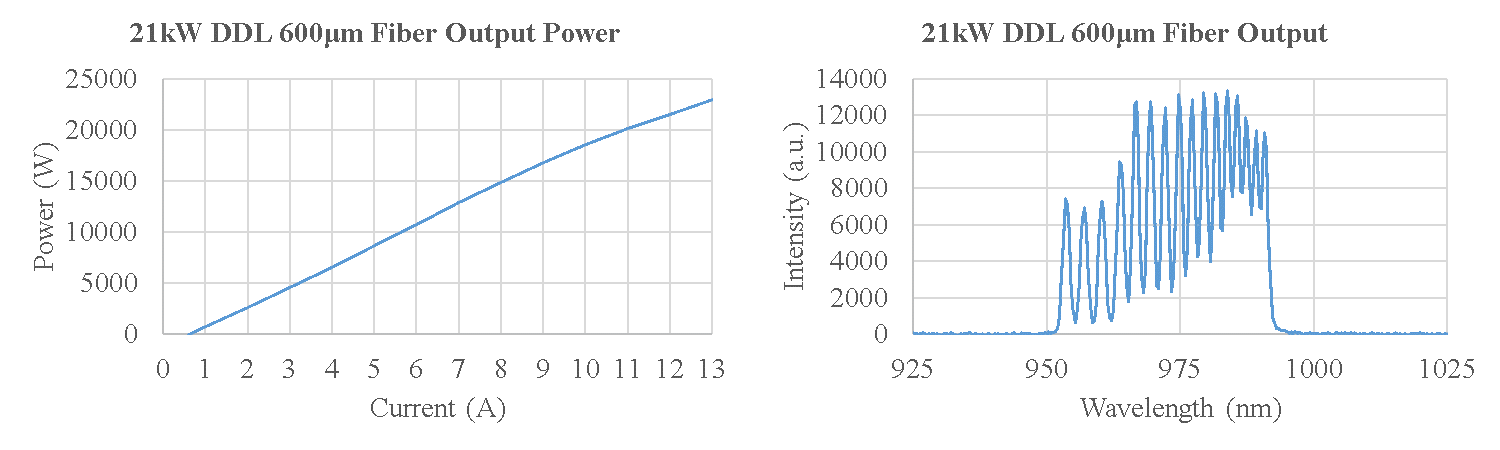
Figure 9. Left: 21kW fiber output DDL laser LI curve. Right: 13A output spectrum.
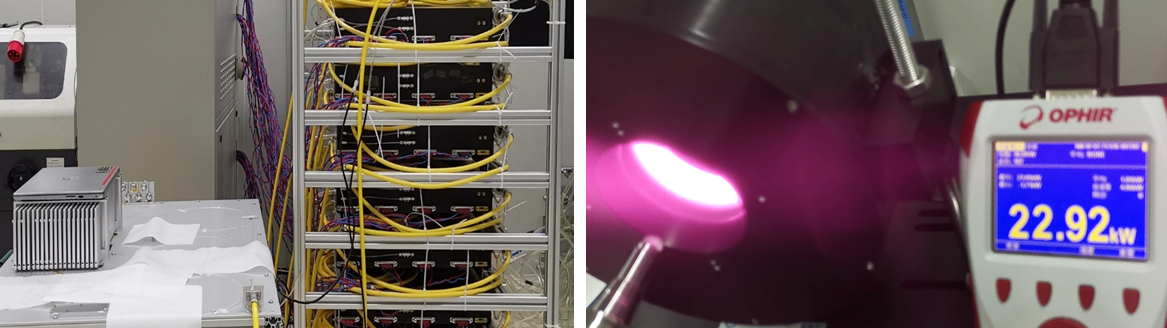
Figure 10. Left: 21kW fiber output DDL laser prototype. Right: 13A output power.
5. Summary and Outlook
The technology based on semiconductor laser single-bar chips demonstrates advantages of high electro-optical conversion efficiency and high reliability while improving brightness. Changguanghua has optimized the epitaxial structure and treated the chip emission cavity surface, achieving a wavelength locking range exceeding DWBC under high operating current for single-bar chips. Applying this technology to 20nm spatial output engines, achieving 1.5kW output. Based on 52.1% of reaches and 2.1kW engines, developed 1.5kW types of fiber coupling modules for different fields, 2 with power and brightness exceeding 2kW . If the problem of reaches fiber output end damage can be solved, 50.5% and 300MW/cm2-sr . 100 μ m/0.22 NA QBH 光纤输出端损伤的问题,2kW The output power of the fiber-coupled module will exceed 3.6kW , with output brightness reaching 500MW/cm2-sr . 15 The average power per unit is 1.4kW fiber-coupled modules through a 19X1 beam combiner to synthesize output, achieving 600 μ m/0.22 NA QD fiber output close to 23kW . 2kW If the 19X1 fiber-coupled modules are connected to the 600 μ m/0.22 NA beam combiner, it is expected that the 60kW、 reaches 达到50% fiber output will exceed DWBC . It is foreseeable that applying the DDL technology based on semiconductor laser single-chip chips to other bands can significantly improve the output brightness of lasers in related bands and reduce the corresponding costs.
Acknowledgments
This research was supported by the Key R&D Program of the Ministry of Science and Technology (Project No. 2018YFB1107300 ).
References
- Glick, Y., Fromzel, V., Zhang, J., Ter-Gabrielyan, N., and Dubinskii, M., “High-efficiency, 154 w cw, diode pumped raman fiber laser with brightness enhancement,” Applied Optics 56(3), B97–B102 (2017).
- Redmond, S. M., Creedon, K. J., Kansky, J. E., Augst, S. J., Missaggia, L. J., Connors, M. K., Huang, R. K., Chann, B., Fan, T. Y., Turner, G. W., et al., “Active coherent beam combining of diode lasers,” Optics letters 36(6), 999–1001 (2011).
- Schimmel, G., Janicot, S., Hanna, M., Decker, J., Crump, P., Erbert, G., Witte, U., Traub, M., Georges, P., and Lucas-Leclin, G., “Coherent beam combining architectures for high power tapered laser arrays,” in [High-Power Diode Laser Technology XV], 10086, 100860O, International Society for Optics and Photonics (2017).
- Daneu, V., Sanchez, A., Fan, T., Choi, H., Turner, G., and Cook, C., “Spectral beam combining of a broad-stripe diode laser array in an external cavity,” Optics letters 25(6), 405–407 (2000).
- Yu, H., Tan, S., Pan, H., Sun, S., Li, J., and Wang, J., “Development of a 350 w, 50 μm, 0.15 na wavelength stabilized fiber coupled laser diode module for pumping yb-doped fiber laser,” in [High-Power Diode Laser Technology XVIII], 11262, 112620V, International Society for Optics and Photonics (2020).
- Yu, H., Tan, S., Pan, H., Sun, S., Yu, T., Li, J., and Wang, J., “High efficiency 600 w, 100 μm wavelength stabilized fiber coupled laser diode module for fiber laser pumping,” in [High-Power Diode Laser Technology XIX], 11668, 116680E, International Society for Optics and Photonics (2021).
- Li, J., Yu, H., Yu, T., Gou, Y., Yang, H., and Wang, J., “Design of high efficiency diode laser module for wireless power transmission,” Infrared and Laser Engineering 50(5), 20210147 (2021).
- Liu, Y., Yu, H., Califano, A., Braglia, A., and Perrone, G., “Modeling and optimization of multimode fused fiber combiners,” in [Components and Packaging for Laser Systems II], 9730, 97300N, International Society for Optics and Photonics (2016).
- Karlsen, S. R., Price, R. K., Reynolds, M., Brown, A., Mehl, R., Patterson, S., and Martinsen, R. J., “100-w 105-um 0.15 na fiber coupled laser diode module,” in [High-Power Diode Laser Technology and Applications VII], 7198, 71980T, International Society for Optics and Photonics (2009).
- Bai, J. G., Leisher, P., Zhang, S., Elim, S., Grimshaw, M., Bai, C., Bintz, L., Dawson, D., Bao, L., Wang, J., et al., “Mitigation of thermal lensing effect as a brightness limitation of high-power broad area diode lasers,” in [Novel In-Plane Semiconductor Lasers X], 7953, 79531F, International Society for Optics and Photonics (2011).
- Yu, H., Liu, Y., Braglia, A., Rossi, G., and Perrone, G., “Investigation of collimating and focusing lenses’ impact on laser diode stack beam parameter product,” Applied optics 54(34), 10240–10248 (2015).
Recommended Reading

Address: No.56,Lijiang Road,SND,Suzhou,Jiangsu Province,P.R.China
Mailbox:sales@everbrightphotonics.com
Website:www.everbrightphotonics.com
Phone:+86 0512-66896988
Fax:+86 0512-66806323
Message Board