


Light journal reports the latest research achievements of Changguang Huaxin丨VCSEL achieves a record 74% efficiency at room temperature
03/25
2024
CTO of Changguang Huaxin and Professor Wang Jun's research team from Sichuan University recently published their latest research results in Light: Science & Applications, systematically studying multi-junctions through theoretical simulation combined with experiments. VCSEL Advantages in electro-optical conversion efficiency. Simulations show that a 20-junction VCSEL can achieve over 88% efficiency at room temperature. Experiments have realized a 15-junction VCSEL achieving a maximum efficiency of 74% at room temperature. The corresponding differential quantum efficiency exceeds 1100%, representing the highest electro-optical conversion efficiency and differential quantum efficiency reported for VCSELs to date, breaking the nearly 20-year stagnation in VCSEL efficiency development and changing the inherent perception that VCSELs cannot surpass edge-emitting lasers in efficiency!
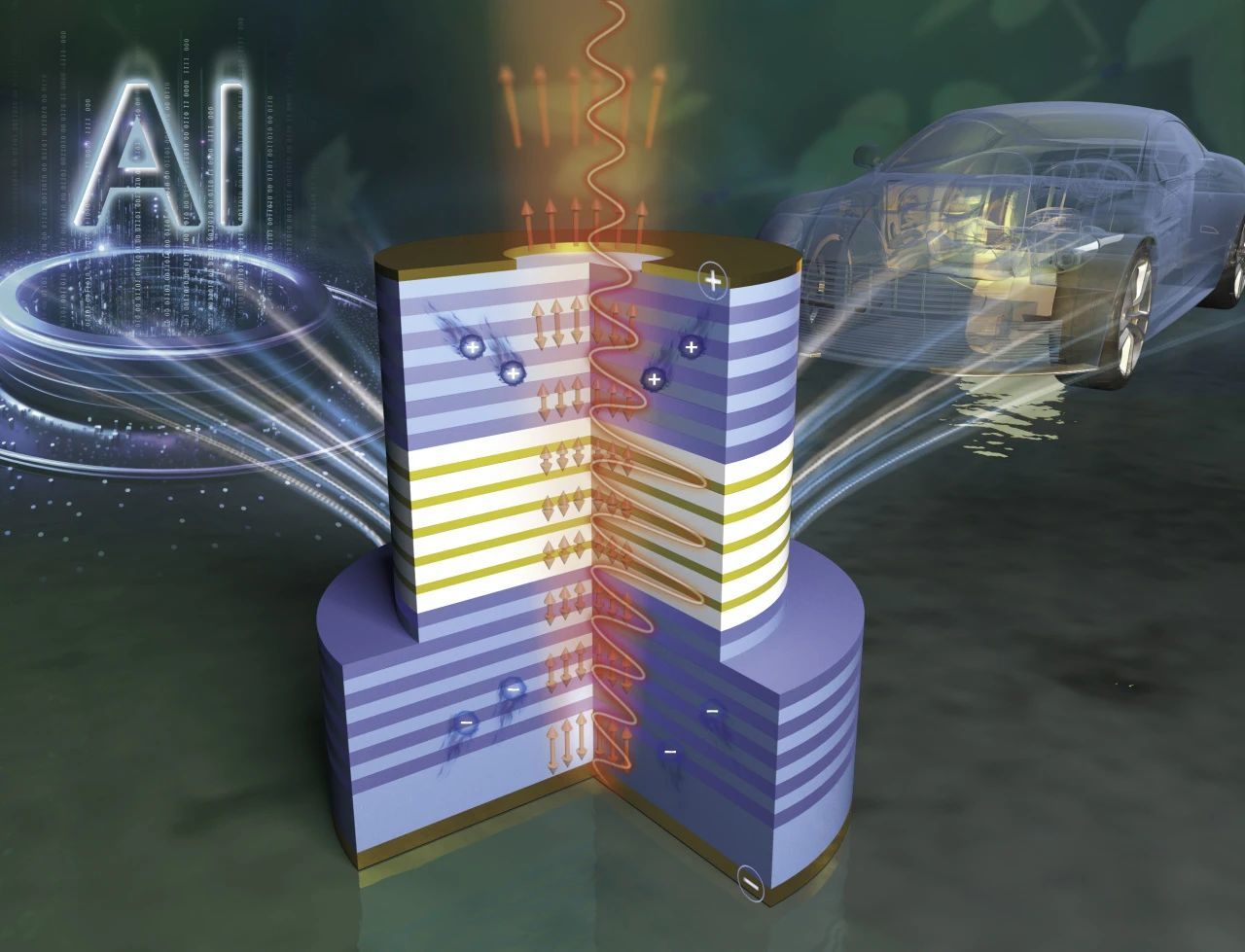
This research will provide valuable reference for the further development and application of high-efficiency semiconductor lasers (especially VCSELs) laser radar, high-speed communication, and data center computing power and will have a significant impact on promoting green energy photonics. .
The related results were published online in Light: Science & Applications under the title "Multi-junction cascaded vertical-cavity surface-emitting laser with a high power conversion efficiency of 74%." Xiao Yao, a doctoral researcher at Sichuan University, is the first author, and Professor Wang Jun is the corresponding author.
Light: Science & Applications

Light: Science & Applications was launched on March 29, 2012. It is an all-English open-access international optics academic journal co-published by the Changchun Institute of Optics, Fine Mechanics and Physics, Chinese Academy of Sciences, and the UK Nature Publishing Group ( NPG ). It was indexed by the internationally renowned databases SCI and Scopus in October 2013, with an impact factor of 19.4. It has ranked among the top 3 optical journals worldwide for 9 consecutive years, belongs to SCI Zone 1, and holds high influence and academic standards in the field of optics journals, being one of the top journals. It is also a leader among domestically produced Chinese journals, having won the title of "China's Most Internationally Influential Academic Journal" for 8 consecutive years.
Since the advent of semiconductor lasers, one of their most notable advantages compared to other types of lasers has been the ability to achieve extremely high electro-optical conversion efficiency. Pursuing ultra-high efficiency in semiconductor lasers remains an important goal in photonics and laser physics. Edge-emitting semiconductor lasers ( EEL ) have continuously broken records for power conversion efficiency (PCE) since their inception, reaching a historic high of 85% at -50°C in 2006. Subsequently, in 2007, EELs also achieved a high efficiency of 76% at room temperature. However, no new efficiency records have been set in the following fifteen years, and these records have remained the highest for semiconductor lasers. Unlike EELs, vertical-cavity surface-emitting lasers (VCSELs) have shown slower efficiency improvement. Since the report of a highest PCE of 62% in 2009, no significant breakthroughs have been made, indicating a clear performance gap with EELs. As microcavity lasers, VCSELs have faced challenges in achieving high-efficiency conversion in the field of photonics.
Due to their low power and efficiency, early VCSEL applications were mainly in small, low-power consumer electronics and short-distance communication in data centers. In recent years, with advances in smart technology, low-power VCSELs have become key core light source chips in intelligent sensing systems, widely used in facial recognition and short-distance sensing, achieving significant success. Recently, rapid development in advanced artificial intelligence technology has made VCSELs have huge application potential in sensing, communication, atomic clocks, optical/quantum computing, topological lasers, and medical inspection. Especially, long-range sensing technology for autonomous driving, AI computing power demands in high-speed data processing centers, and the growth of VCSELs in intelligent and quantum technology applications highlight energy consumption as a core issue. VCSEL energy efficiency significantly impacts power consumption in mobile devices and data centers. Therefore, developing ultra-high-efficiency VCSELs is crucial to support the development of terminal devices in the future intelligent era and has important implications for promoting green energy photonics.
However, as early as 1984, Professor Kenichi Iga from Tokyo Institute of Technology proposed an innovative design method, as shown in Figure 1, using reverse tunnel junctions to cascade active regions to increase gain volume. This design strategy allows carriers to undergo multiple stimulated emission processes, thereby not only improving the device's differential quantum efficiency but also maintaining a low threshold current. Therefore, in recent years, many researchers have used multi-junction VCSELs to achieve exponential power growth, making VCSELs usable as laser radar light sources for autonomous vehicles. However, the most significant potential advantage of multi-junction VCSELs should be their remarkable efficiency improvement. Thus, a systematic study combining theoretical simulation and experiments was conducted on the advantages of multi-junction VCSELs in electro-optical conversion efficiency.
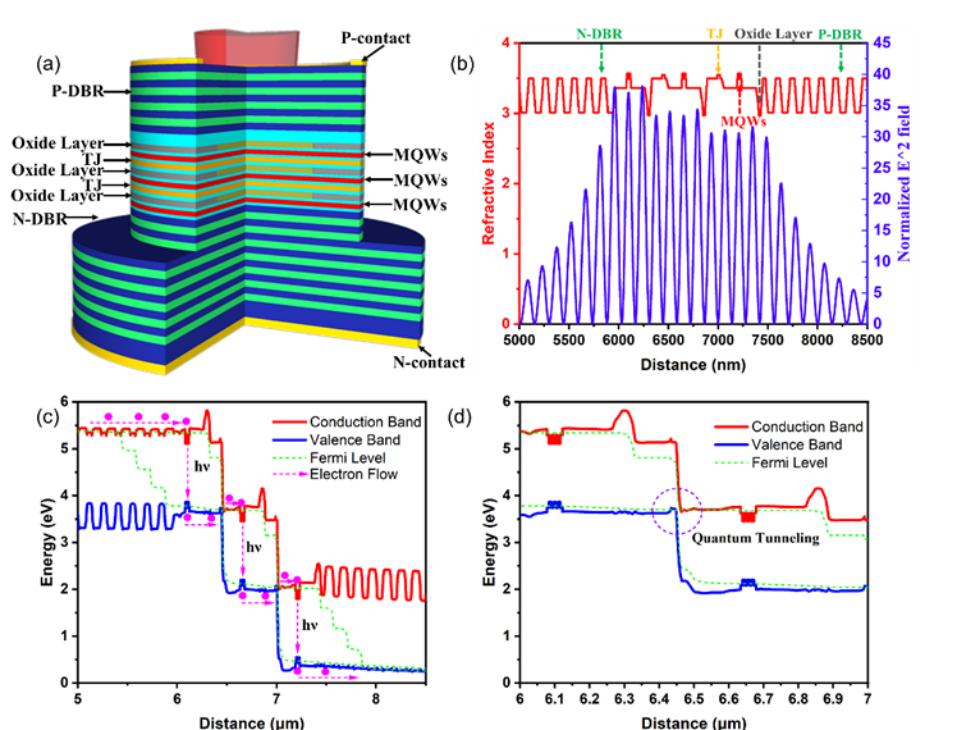
Figure 1 (a) Structural schematic, including N-type distributed Bragg reflector (N-DBR), P-type distributed Bragg reflector (P-DBR), multiple quantum wells (MQW), oxide layer, tunnel junction (TJ); (b) refractive index distribution and standing wave optical field distribution of 3-junction VCSEL; (c) active region band structure, cascading multiple active regions through tunnel junctions to realize multiple electron transition mechanisms; (d) tunnel junction band structure under bias.
Simulation results shown in Figure 2 indicate that as the number of junctions in the VCSEL increases, the PCE significantly improves. A 20-junction VCSEL can achieve 88% electro-optical conversion efficiency, which surpasses the highest PCE value reported under low-temperature operating conditions in EEL experimental studies.
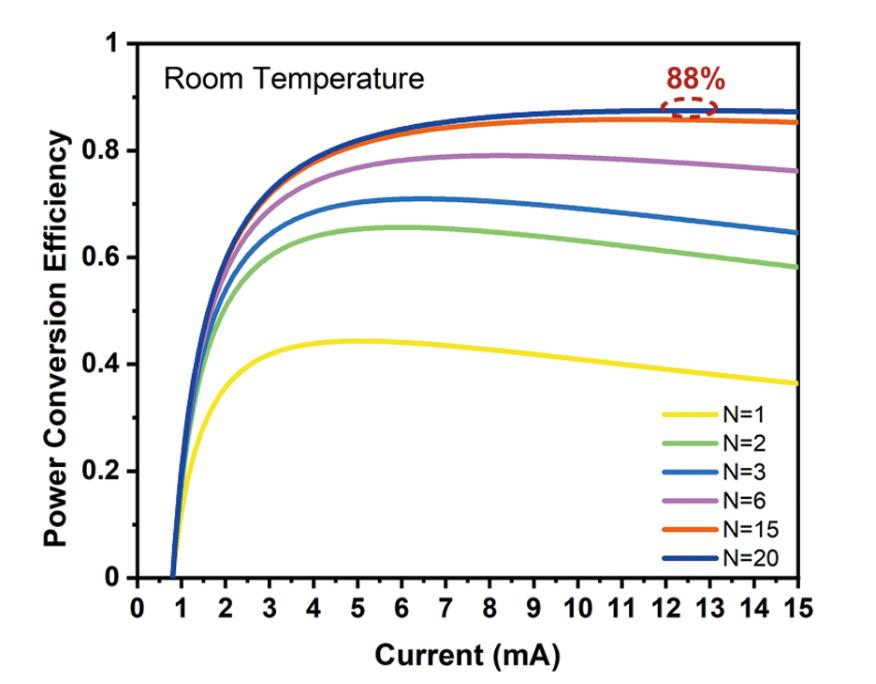
Figure 2 Numerical simulation of PCE for VCSELs with different numbers of junctions.
Researchers fabricated VCSEL devices with different numbers of junctions and tested their performance. Experimental results shown in Figure 3 indicate that a 15-junction VCSEL achieves a peak power exceeding 100 mW at 7 mA current, with a maximum electro-optical conversion efficiency of 74% and a slope efficiency of 15.6 W/A (with differential quantum efficiency exceeding 1100%), representing the highest electro-optical conversion efficiency and differential quantum efficiency reported for VCSELs to date.
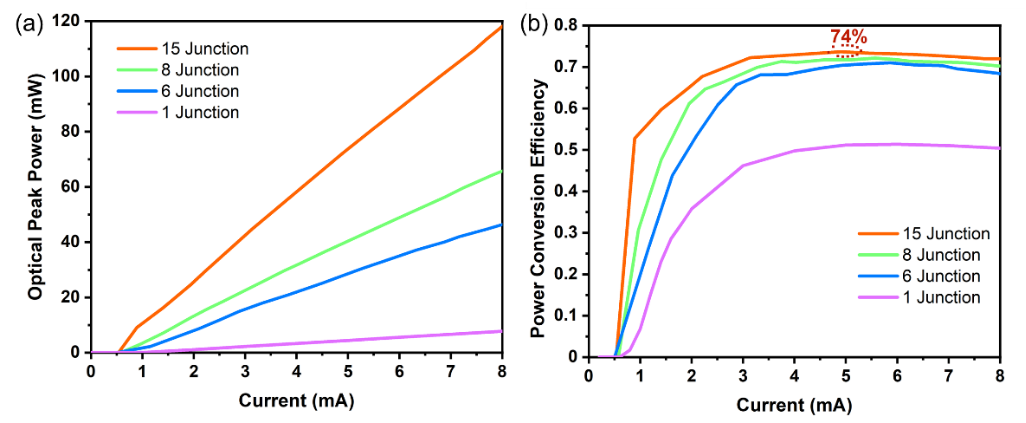
Figure 3 (a) L-I-V characteristics of VCSELs with different numbers of junctions.
(b) Electro-optical conversion efficiency of VCSELs with different numbers of junctions.
To further investigate the mechanism of enhanced electro-optical conversion efficiency in 15-junction VCSELs, researchers conducted a detailed power consumption analysis based on LIV data. As shown in Figure 4, the energy consumption proportions of single-junction and 15-junction devices were compared. Clearly, with the increase in the number of junctions, the main reduction in energy consumption is attributed to the decrease in the proportion of Joule heating caused by resistance and the internal loss caused by free carrier absorption. This is because: as the number of junctions increases, the gain of the multi-junction VCSEL multiplies, while the cascaded active layers share a single resonant cavity, so the resistance and absorption losses do not multiply accordingly. Therefore, the proportions of Joule heating and internal loss decrease, leading to efficiency improvement. However, for multi-junction EELs, their structure is merely a spatial stacking of single-junction EELs, so they cannot achieve efficiency improvement, and the increased power is just the superposition of uncorrelated beams.
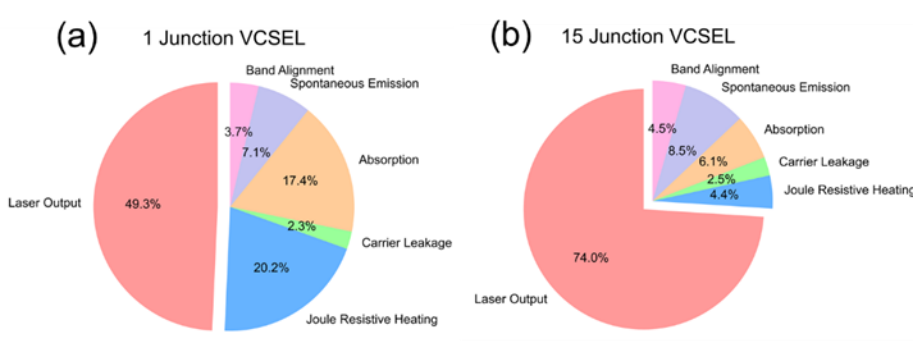
Figure 4 (a) Single-junction VCSEL energy consumption ratio (b) 15-junction VCSEL energy consumption ratio
Researchers have compiled the efficiency development chart of semiconductor lasers over the years, as shown in Figure 5. As the reviewer mentioned: this is indeed an important breakthrough in a long-stagnant field.
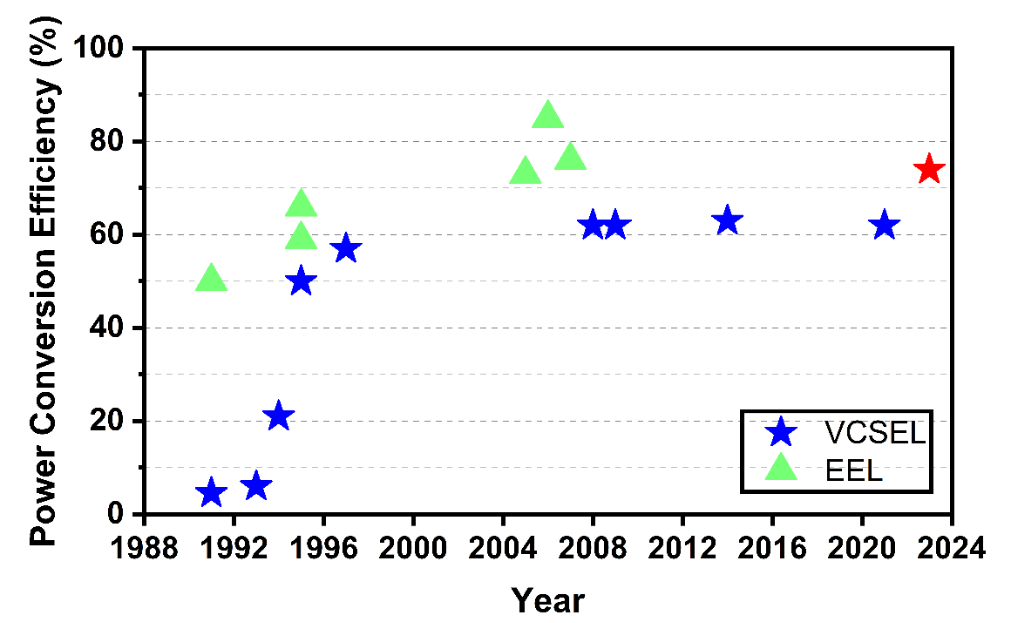
Figure 5 Summary of electro-optical conversion efficiency of semiconductor lasers
Summary and Outlook
We simulated the scaling characteristics of multi-junction VCSELs and compared them with single-junction VCSELs. Numerical simulations show that the electro-optical conversion efficiency of a 20-junction VCSEL can exceed 88% under ambient temperature conditions. Experimentally, a 15-junction VCSEL achieved 74% electro-optical conversion efficiency at room temperature, with a slope efficiency of 15.6 W/A, corresponding to a differential quantum efficiency exceeding 1100%. To our knowledge, this electro-optical conversion efficiency is the highest reported so far in the VCSEL field, and this differential quantum efficiency is the highest reported among semiconductor lasers to date. In the future, we also plan to explore the expansion of high-efficiency, high-power multi-junction VCSEL applications in the communication field. This research not only provides valuable theoretical and experimental evidence for further optimization and application of VCSELs but also offers valuable references for the further development and application of high-PCE semiconductor lasers, having a significant impact on green energy photonics and laser physics.
Paper information Xiao, Y., Wang, J., Liu, H. et al. Multi-junction cascaded vertical-cavity surface-emitting laser with a high power conversion efficiency of 74%. Light Sci Appl 13, 60 (2024). https://doi.org/10.1038/s41377-024-01403-7
Recommended Reading

Address: No.56,Lijiang Road,SND,Suzhou,Jiangsu Province,P.R.China
Mailbox:sales@everbrightphotonics.com
Website:www.everbrightphotonics.com
Phone:+86 0512-66896988
Fax:+86 0512-66806323
Message Board